There are places in Britain that carry their weather like a second architecture — where the light, the fog and the salt air do as much to define a town as the stone and slate of its buildings. St Ives is one of those places.
Tucked into the north-western shoulder of Cornwall, facing the Atlantic on one side and the calm waters of its own harbour on the other, St Ives has spent centuries being shaped by the sea. It has been a fishing port, a pilchard-curing town, a smugglers' refuge, a artists' colony and a holiday destination. In every era, it has resisted becoming just one thing.
What follows is not a guide. It is an attempt to describe a town that feels, at certain hours of the day, less like a place you visit and more like a place that has been waiting for you to arrive.
The Harbour at Night
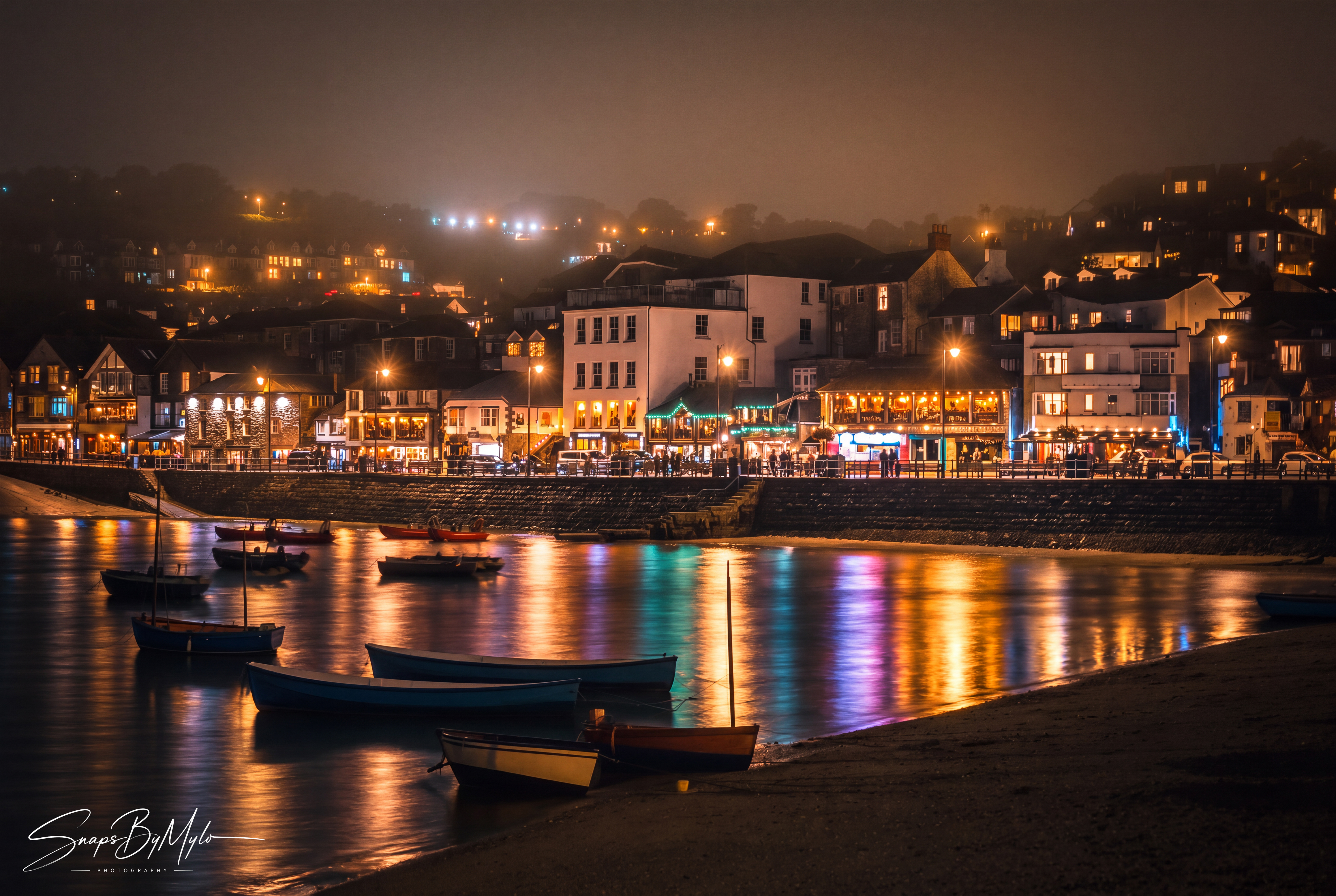
Arrive in St Ives after dark and the town reveals itself first as a single, glowing image: the harbour.
The stone quay runs in a low, protective crescent around a basin of water so still at low tide that the buildings opposite appear twice — once in stone and once in reflection. Warm yellow light spills from cottage windows and street lamps, stretching in long, trembling columns across the surface of the harbour. A handful of small boats lie moored or beached on the sand, their hulls catching fragments of that same golden glow.
It is the kind of scene that makes photographers cancel their plans for the morning and stay.
The silence is not absolute. There is the soft lap of water against the quay wall, the distant clatter of a pub door, the occasional cry of a gull unsettled by something in the dark. But there is a hush to the harbour at night that feels deliberate — as though the town has collectively agreed, after centuries of early mornings and tides and hard weather, to keep the evening for itself.
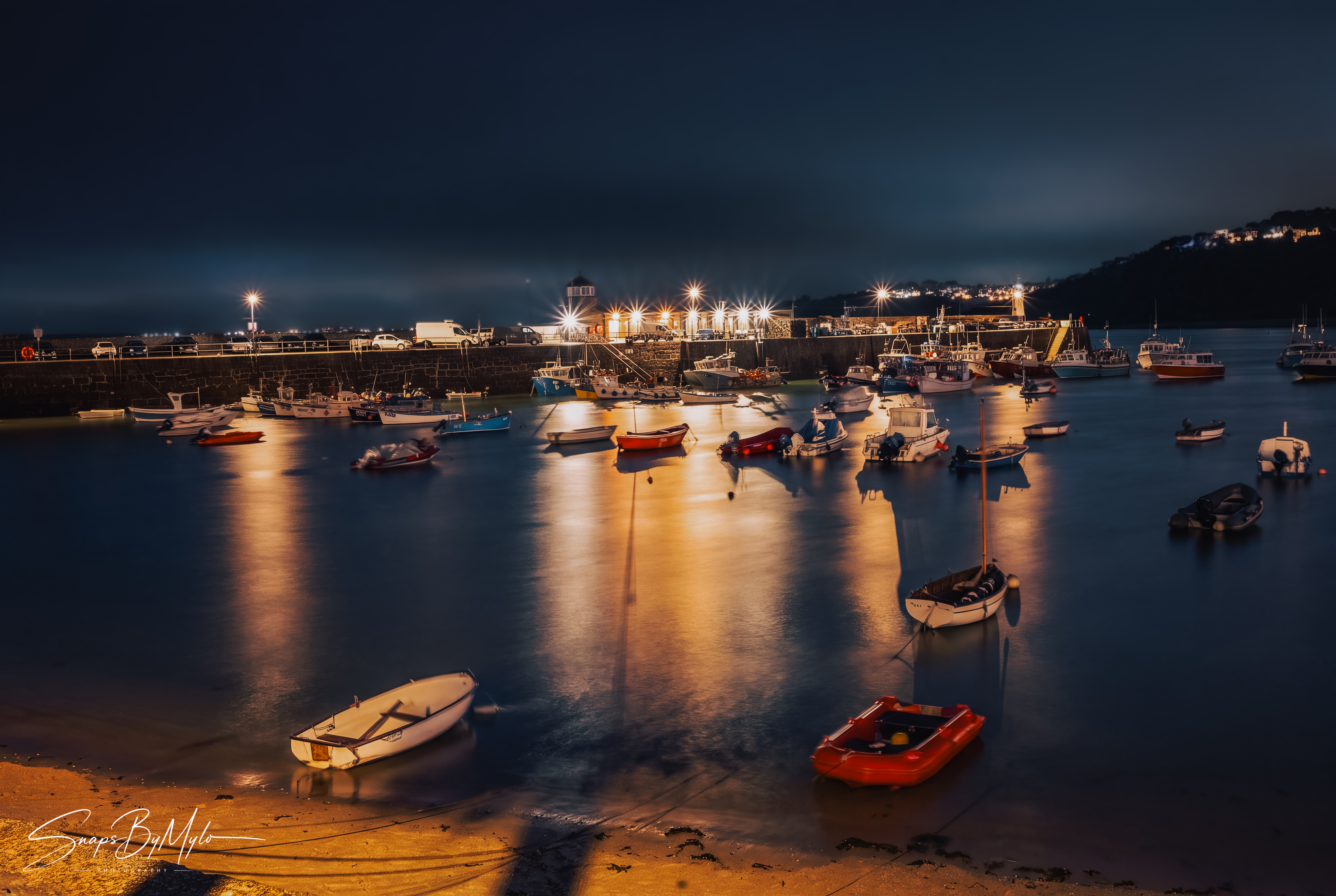
Stand on the beach at the edge of the harbour and the reflection becomes almost more real than the town itself. An orange inflatable dinghy sits bright against the dark sand. A white boat rests a little further along. The harbour wall, lined with its upright lamps, glitters like a string of fallen stars. Behind it, the hillside town climbs in layers, each window a small amber square against the black slope.
This is the St Ives that postcards try and fail to capture — not because the image is difficult to photograph, but because what makes it work is the stillness, and stillness doesn't print.
A Town Built on Water
To understand St Ives, you have to understand that the sea is not beside the town. The sea runs through it.
The harbour sits at the bottom of a natural amphitheatre, and the town rises behind it in steep, narrow streets that were laid out long before the motor car. Fishermen's cottages crowd the slopes, their whitewashed walls and slate roofs stepping over one another toward the light. Many of the streets are so narrow that two people cannot comfortably pass without one of them turning sideways.
This is not a design choice. It is the footprint of a working harbour town that was built for people on foot, for boats to be hauled up the beach, for pilchards to be salted in cellars and for nets to be dried on the quays. The town grew where the work was, and the work was on the water.
Today the pilchard trade is gone, and the fishing fleet is a fraction of what it once was. But the architecture remains, and with it a particular kind of Cornish logic: buildings pressed close together for warmth, streets angled to follow the slope, and a harbour at the centre of everything because the harbour was, for hundreds of years, everything.
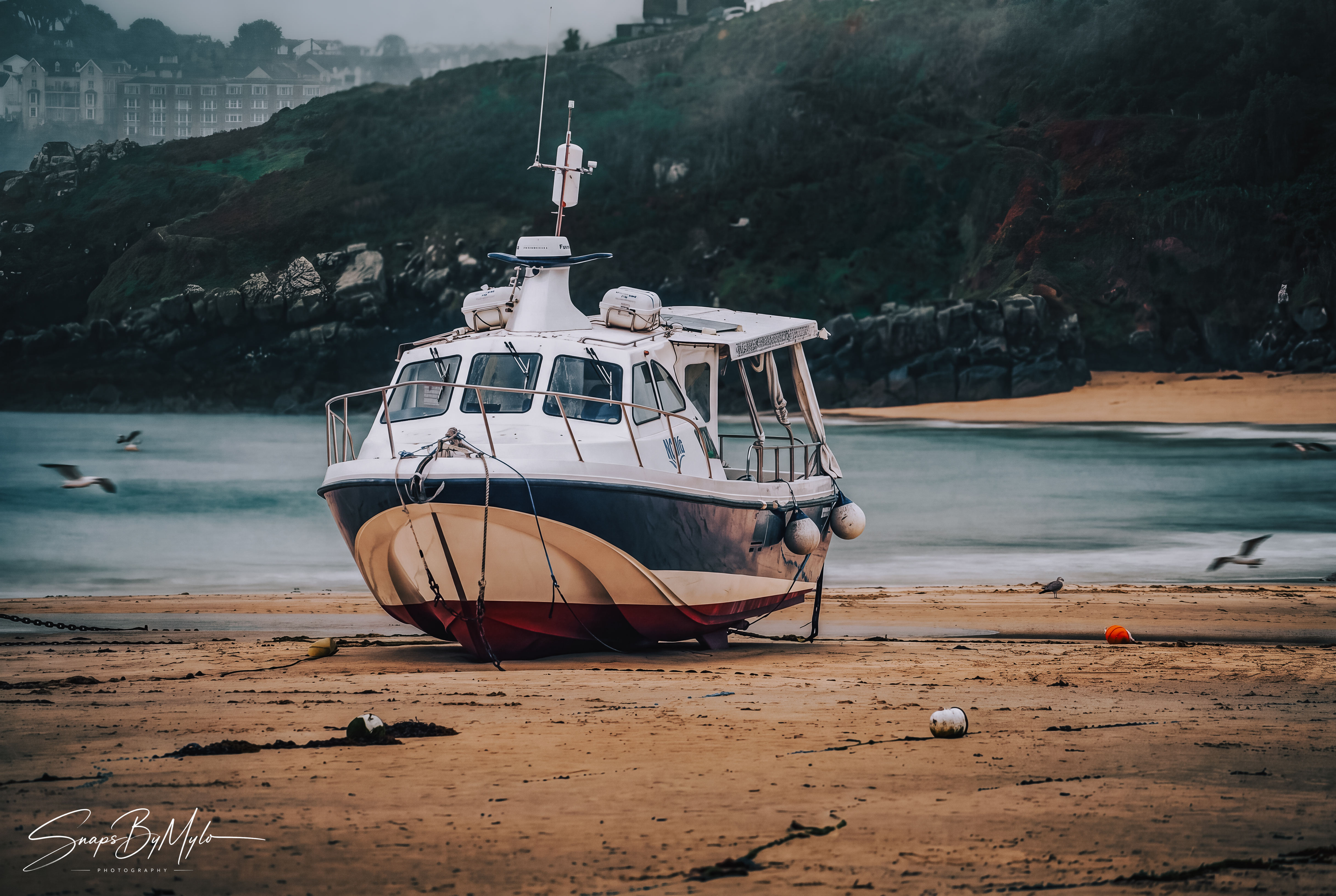
Walk the harbour at low tide and you will find boats where boats have always been found: on the sand.
A white motorboat sits beached, its hull dark blue and red, its cabin windows catching the grey light of an overcast morning. Buoys — yellow, orange, white — lie scattered nearby like punctuation marks without a sentence. A thin chain runs across the sand toward the bow. Two gulls wheel overhead, their shapes blurred by motion.
There is something quietly affecting about a boat on land. A vessel is built for water, and seeing one resting on a beach is a reminder that even the most purposeful things in this town are governed by the tide. The boats come in. The boats go out. And the beach, in between, belongs to no one and everyone.
The Light That Painters Came For
St Ives has a second reputation, almost as old as its fishing one, and it concerns the light.
Artists began arriving in serious numbers in the late nineteenth century, drawn by the clarity and quality of the coastal light — a light that, because of the town's position on a narrow peninsula, arrives from both the Atlantic and the English Channel and seems, at certain hours, to bounce off the sea and fill the streets from below.
J.M.W. Turner visited. So did Whistler. By the 1920s and 30s, the town had become one of the most important centres of modern British art, home to Ben Nicholson, Barbara Hepworth, Naum Gabo and a circle of painters and sculptors for whom the Cornish coast was not merely a subject but a way of seeing.
The Tate St Ives, perched above Porthmeor Beach, is the institutional legacy of that history. But the light itself is the older and more important institution. It is why photographers still come, and why, on a soft overcast morning, the town can feel less like a holiday destination and more like a waiting room for a painting that hasn't been painted yet.
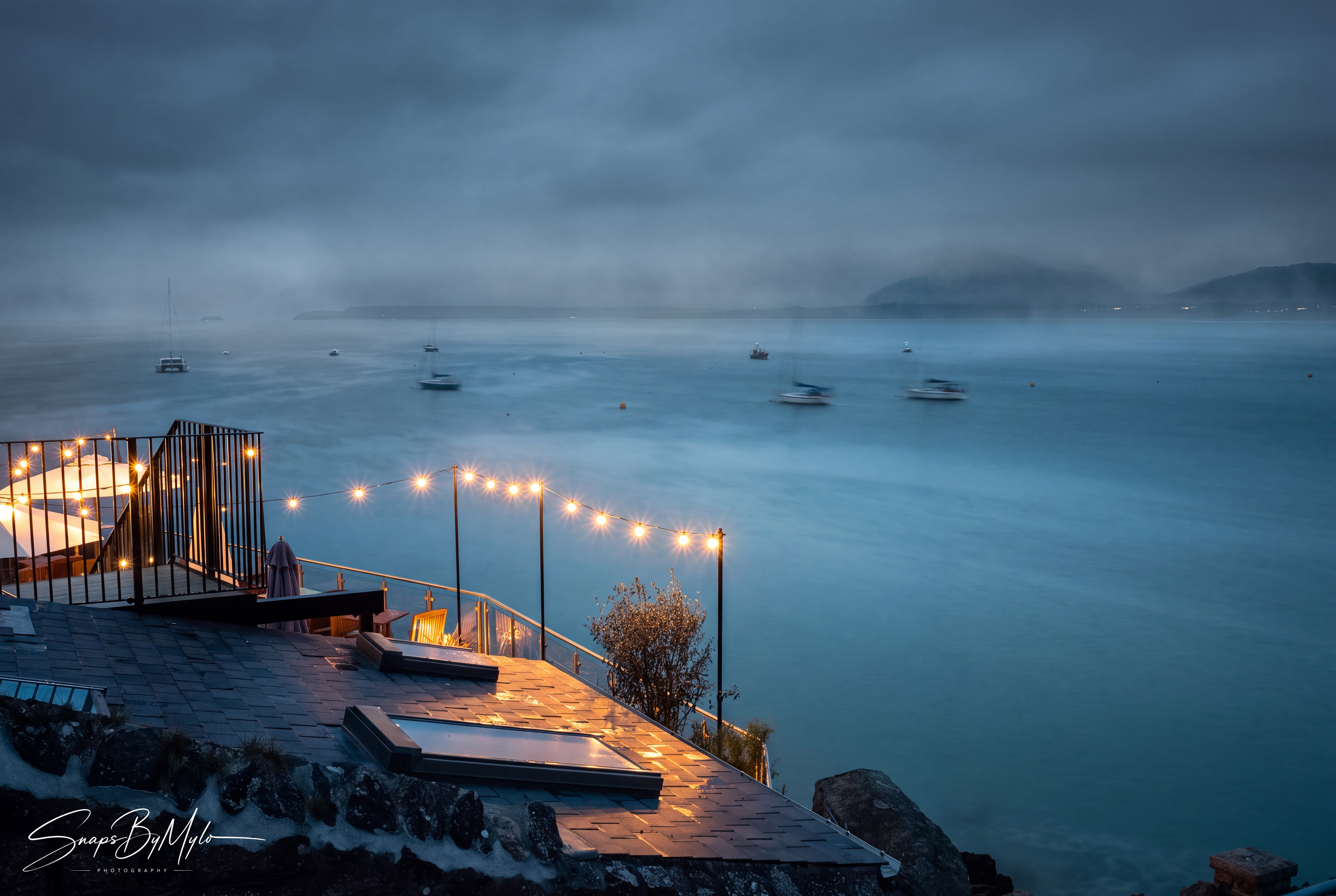
Nowhere is that quality of light more evident than at twilight, when the sky drops into deep slate blue and the first lights of the evening begin to glow against it.
A terrace sits above the rocks, its slate tiles dark and wet, a row of string lights strung between black metal poles casting small warm pools of amber across the deck. Beyond the railing, the sea stretches out flat and featureless under a low, heavy sky. A few boats sit on the water, barely visible in the dimness. The horizon has all but disappeared into the cloud.
This is blue hour in St Ives, and it is the town at its most honest. The day's colour has drained away, and what is left is structure: the shapes of boats, the line of a quay, the geometry of a terrace, the glow of a lamp. In that reduced light, the town becomes almost abstract — a study in dark and warm, in water and stone, in the distance between where you are standing and where the sea begins.
Where the Town Meets the Sea
St Ives has two faces, and they are separated by a walk of about five minutes.
On the harbour side, the town is sheltered, reflective, almost Mediterranean in its calm. On the Porthmeor side, facing the open Atlantic, it is something else entirely — exposed, windswept, and beaten by a sea that has crossed three thousand miles of open water before it arrives at the sand.
Porthmeor is the beach most people associate with St Ives, and it earns that association. At low tide it is a wide, clean crescent of pale sand; at high tide, the waves come right to the wall below the Tate. It is the town's surf beach, its sunset beach, and, on a stormy day, its most dramatic edge.
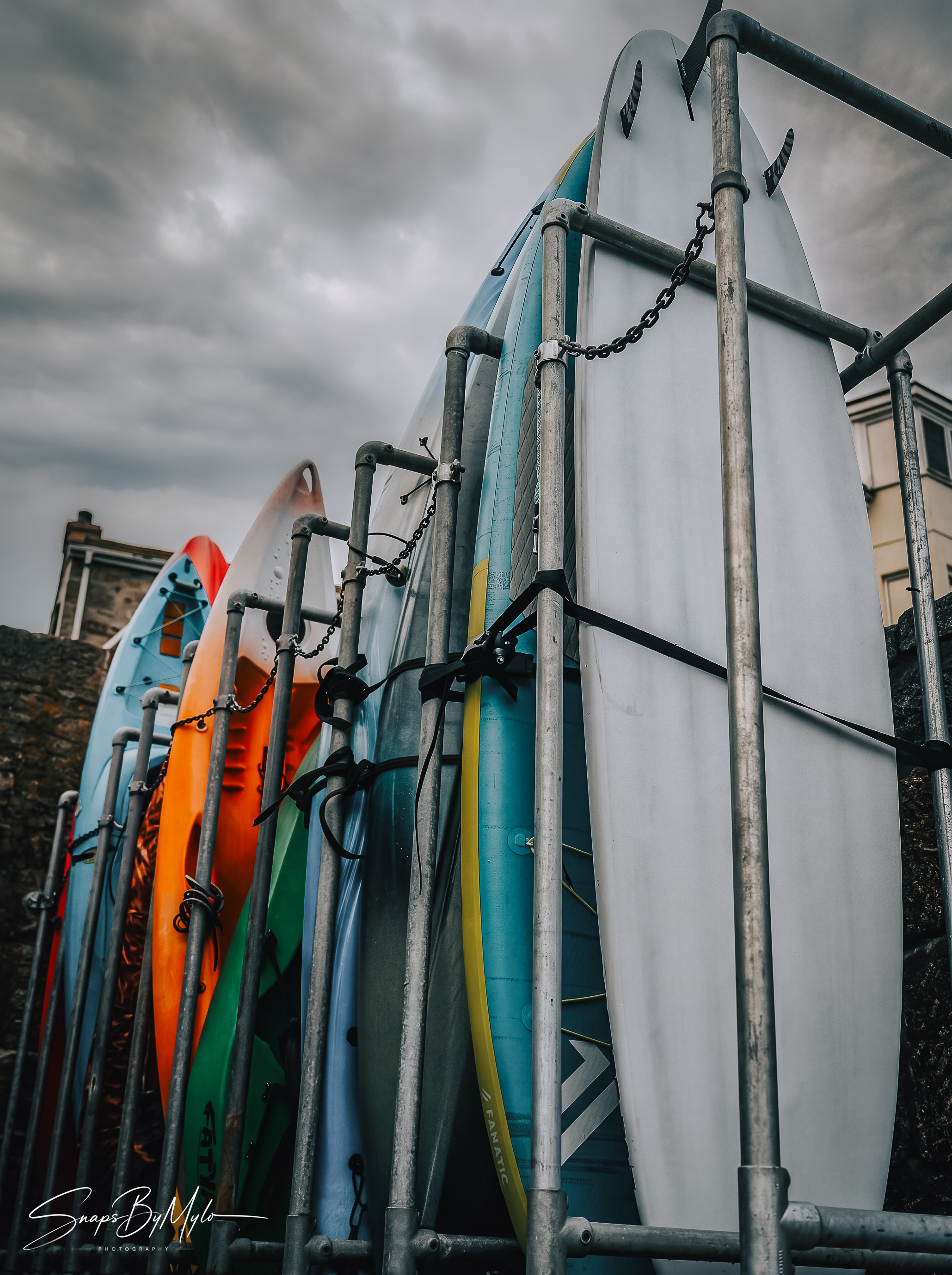
On the edge of the beach, racked vertically in a metal frame, sit the tools of a newer St Ives: surfboards, paddleboards, kayaks. A white SUP stands tallest, a blue Fanatic board beside it, an orange kayak and a smaller blue one nestled behind. Chains secure them to the scaffolding. The sky above is heavy and dark, the kind of sky that promises either rain or a clearing wind, and refuses to say which.
The surf rack is, in its small way, a portrait of modern Cornwall. The fishing boats are fewer now, but the water is still the town's reason for being — it's just that the relationship has changed. Where boats once went out for fish, boards now go out for waves. The sea is still worked, but it is also, increasingly, played on.
There is no loss in this, only a shift. The town still belongs to the water. It simply wears different boots now.
The Details That Make a Place
What separates a town you remember from a town you forget is rarely the view. It is the detail.
St Ives is a town of details. The way a cottage door is painted dark navy, its vertical planks showing the grain of the wood through the paint. The way a brass anchor door knocker tarnishes in the salt air, its high points burnished gold and its recesses darkened to a deep, antique bronze. The way a letter plate is set into the same door, the word LETTERS embossed in worn serif capitals, surrounded by scrollwork that nobody under thirty would think to commission today.
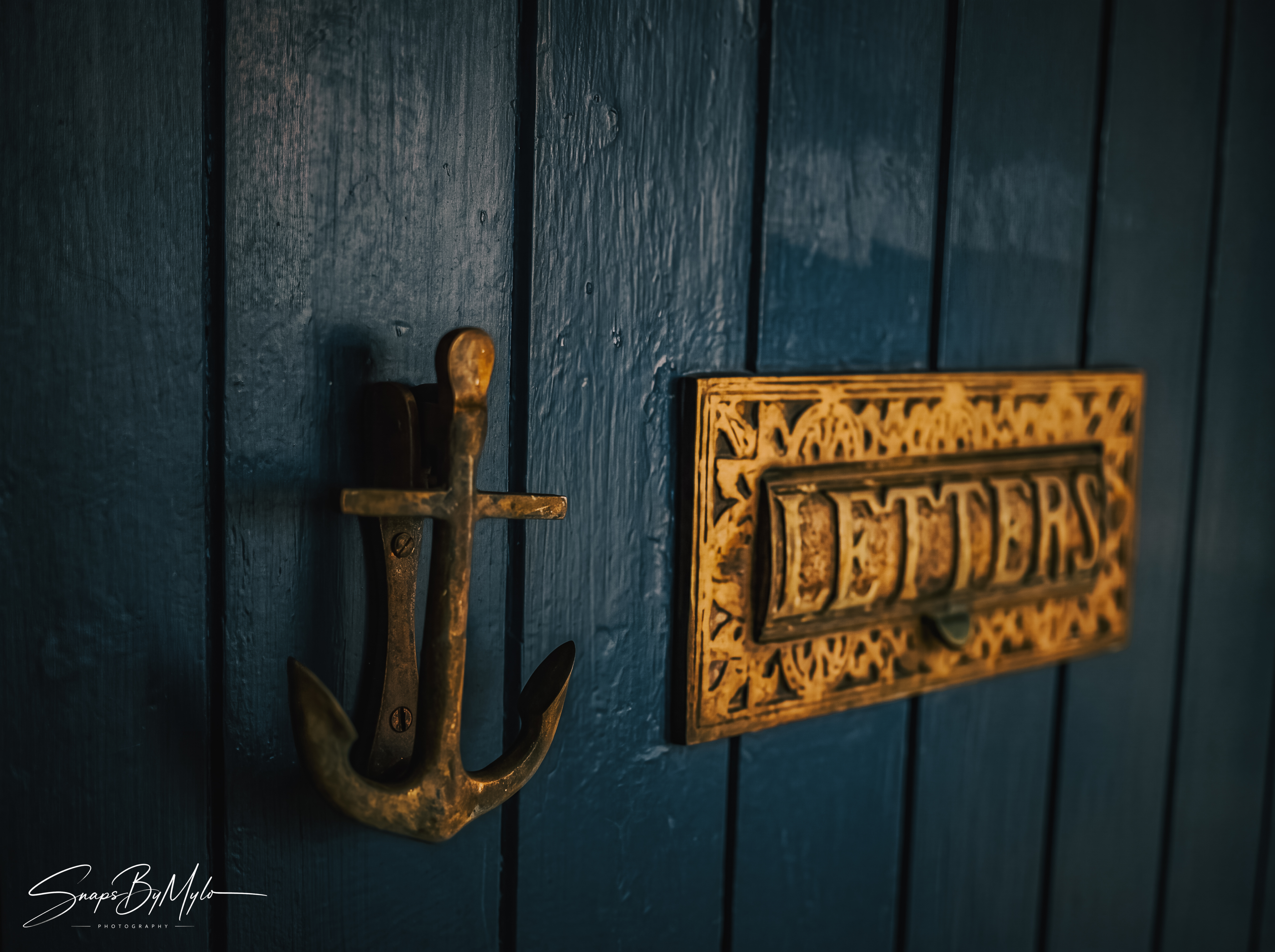
These are not grand features. They are the small, deliberate marks of a town that was built by people who expected their doors to be looked at — not by tourists, but by neighbours. A door knocker is a gesture toward the person approaching. A letter plate is a gesture toward the person writing. Neither is necessary, and both, in their small way, are why St Ives feels like a place that has been lived in rather than simply built.
Walk the backstreets away from the harbour and you find more of this. Slate steps worn into shallow curves by generations of feet. Granite lintels carved with dates from the 1800s. Window frames painted in the particular pale blue-green that seems, for reasons no one can quite explain, to belong only to Cornwall. A town is not its monuments. A town is its thresholds.
Weather, and the Things Weather Leaves Behind
St Ives is a town that knows weather the way a city knows traffic — as a constant, shaping, unavoidable condition.
The Cornish coast is the first land the Atlantic weather reaches, and it arrives with full force: salt wind, horizontal rain, sea fog that rolls in off the water and fills the streets so completely that you can stand on the harbour and not see the other side. There are mornings in St Ives when the town is not so much misty as partly submerged.
But weather in St Ives is not simply an inconvenience. It is a collaborator. The same fog that hides the harbour softens the lines of the town until every building looks like a watercolour of itself. The same rain that sends visitors into the cafes darkens the slate and makes it gleam. The same salt wind that peels the paint from the cottages is the wind that, for centuries, brought the fishing fleet home.
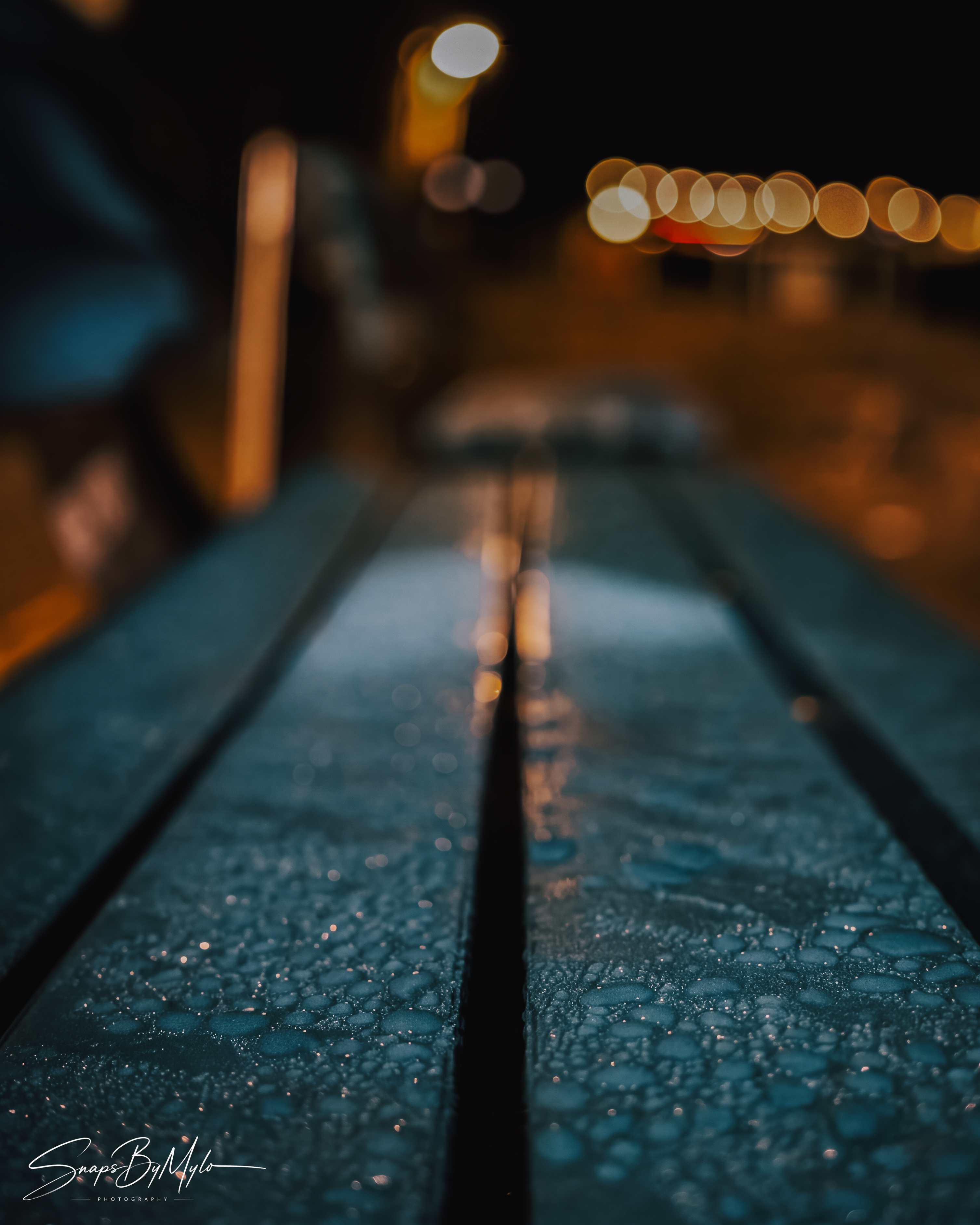
On a morning after rain, the wooden planks of a quay or terrace are covered in small, perfect droplets — each one a tiny lens holding a blurred image of the world around it. In the foreground the wood is dark and wet, its grain visible under the water. In the background, out of focus, the warm amber circles of distant lamps float like small suns.
This is the St Ives that is easy to miss: the St Ives of surfaces, of textures, of the way water sits on wood and wood holds the memory of water. The town is full of these moments, but they require a certain kind of attention — the willingness to stop walking, to look down, to notice that the ground under your feet is, in its own quiet way, beautiful.
The Edge of the Town
Walk far enough along the coast from the harbour and the town falls away. The cottages thin. The streets end. The path turns to rock and the rock turns to sea, and you arrive at the edges of St Ives — the headlands, the piers, the places where the human town gives way to something older and less interested in us.
It is here, at the town's edge, that you find the lighthouse.
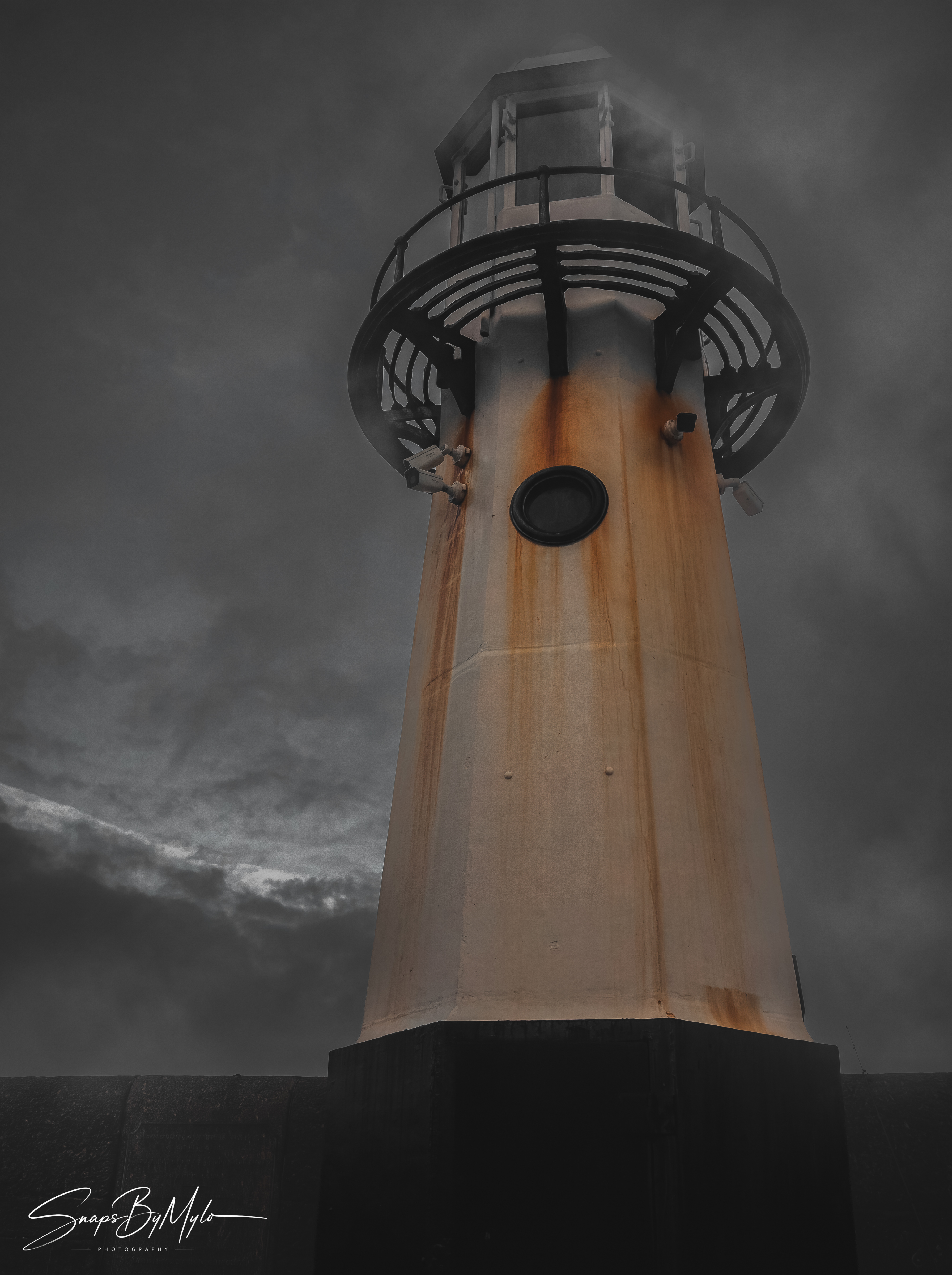
It stands octagonal and white against a dark, louring sky, its surface streaked with rust-coloured vertical stains where decades of rain have run the iron of its fittings down its walls. Near the top, a railed gallery circles the tower. Above it, the lantern room sits with a faint mist clinging to its glass, as though the light inside is still warm.
Two small security cameras are mounted on the exterior, a modern intrusion on an old form. A single porthole window is set into the wall. At the base, the tower meets a dark stone pier, and the whole structure has the look of something that has stood in one place for so long that it has begun, very slowly, to become part of the rock.
Lighthouses are often spoken of as lonely. This one is not. It is simply resolute. It does not need company. It stands at the edge of the town and the edge of the land and says, in its plain white way: this is where the safe ground ends, and the sea begins.
The Birds of St Ives
No account of a Cornish coastal town would be complete without its birds, and St Ives has birds in abundance.
The gulls are the most obvious — bold, loud, opportunistic, and unafraid of people in a way that borders on entitlement. They circle the harbour waiting for chips. They stand on rooftops and scream at one another across the rooftops. They are, in their way, as much a part of the town's soundtrack as the water.
But there are other birds here too, and they are quieter, and they are worth watching for.
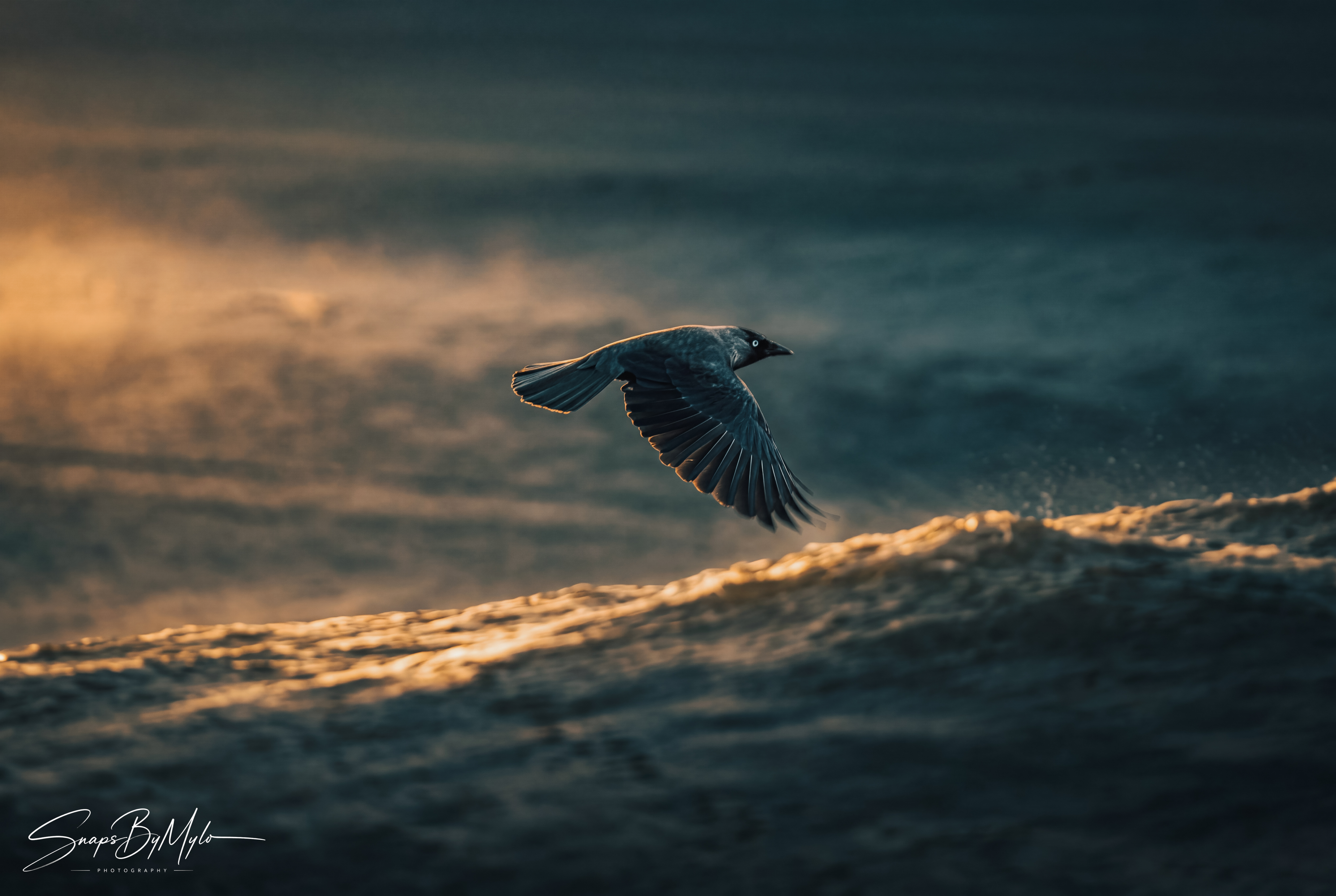
On a morning when the light is low and the sea is rough, a bird — a jackdaw, perhaps, or a young crow — lifts from the rocks and crosses the face of the wave-spray. Its wings are spread, its eye bright, its feathers sharp against the dark sky. Below it, the crest of a wave catches a last, warm light and glows a deep gold against the surrounding blue.
It is a small moment. It is the kind of moment that St Ives produces constantly and that most people, walking to breakfast, do not see. But it is there, if you look — the town's wild life going on around the town's human life, neither much interested in the other.
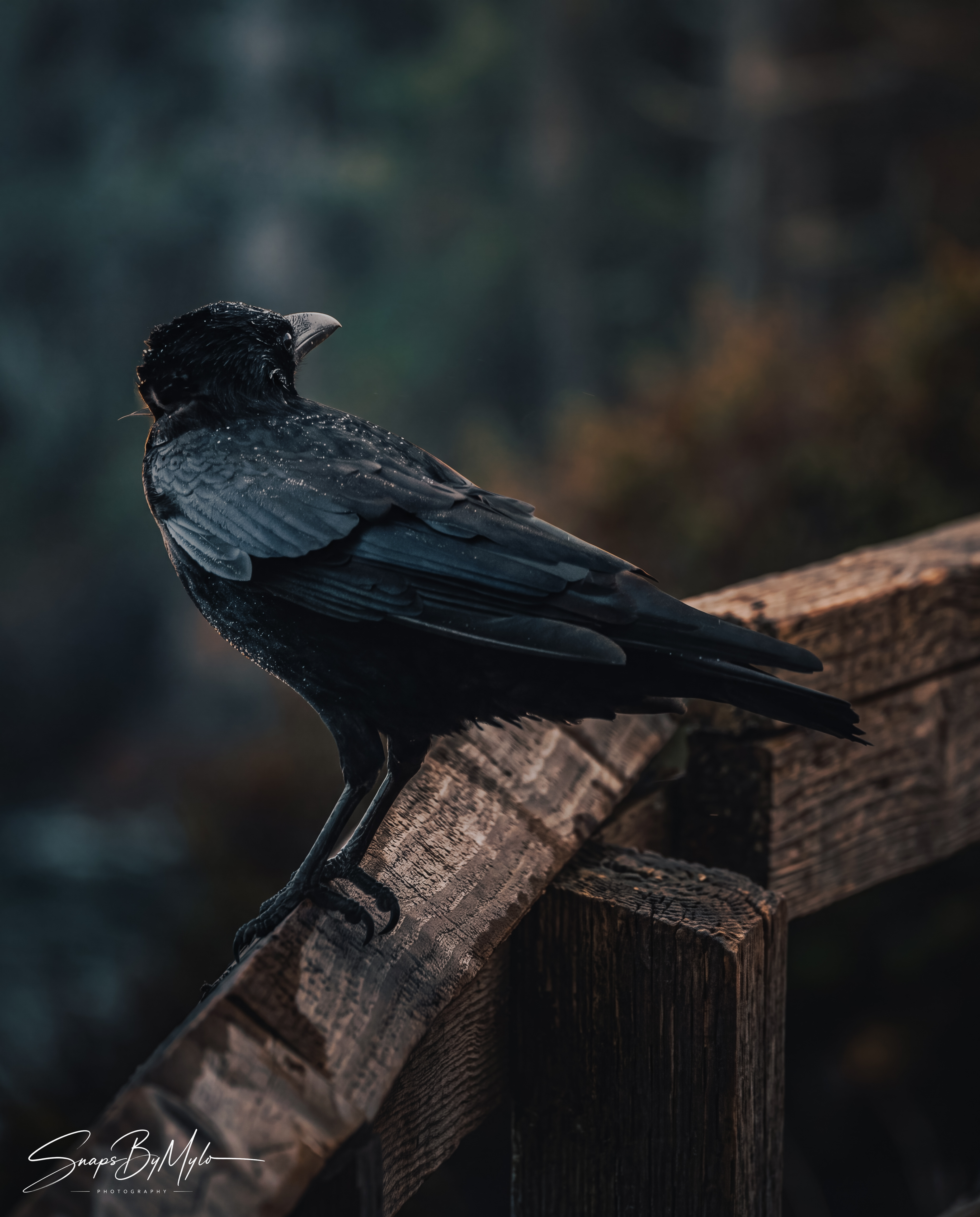
And on a railing not far from the harbour, a crow sits alone.
It is facing away, its head tilted slightly upward, its plumage a deep, iridescent black that catches what light there is and holds it in a faint, oil-slick sheen. Its beak is a pale grey. The railing beneath it is old and weathered, the wood dark and rough, its grain visible in long, worn lines. Behind the bird, the background is a soft blur of greens and browns — the cliffside, the scrub, the edge of the land.
There is nothing remarkable about a crow on a railing. And yet, standing there, watching the bird watch the sea, you have the distinct sense that it knows something about this place that you do not. Which, of course, it does. It was here before you. It will be here after. The town is, for the crow, simply a set of railings to sit on, and the sea simply a place to fly over.
A Town Between Tides
What makes St Ives difficult to write about is that it is not, in the end, one thing.
It is a harbour town and a surf town. A fishing port and an art colony. A place of bright summer crowds and empty winter mornings. A town of grand views and of brass door knockers. A town that faces the Atlantic and shelters in its own bay. A town that is, at the same time, a tourist destination and a working community, a place people come to escape from and a place people have lived in for centuries without any thought of escaping.
What holds it together is not a single feature but a rhythm — the rhythm of the tide, which empties the harbour twice a day and fills it twice a day, which beaches the boats and floats them, which exposes the sand and covers it. The town moves with that rhythm. The fishermen move with it. The photographers move with it. Even the tourists, without quite knowing it, move with it.
St Ives is a town between tides. It is at its best in the moments of transition — when the day turns to evening, when the water turns to glass, when the fog comes in and the town becomes, for a few hours, not a place on a map but an image in the air.
And then the tide turns, the fog lifts, the boats float, and the town goes back to being itself: ordinary, extraordinary, and entirely its own.