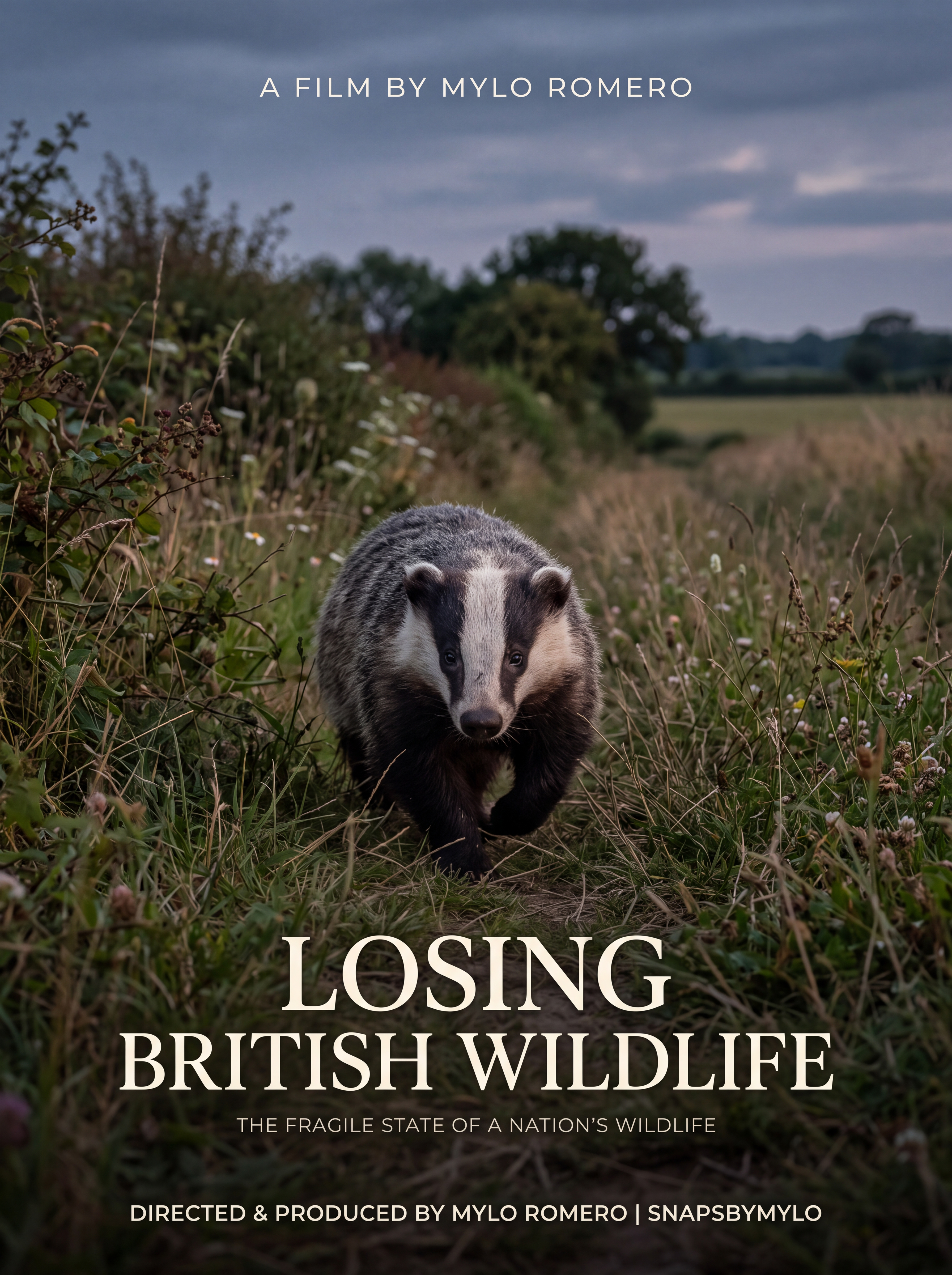
A new 60-minute documentary exploring the decline of Britain's wildlife has surpassed 200 million streams online — another extraordinary milestone for wildlife conservationist and photographer Mylo Romero, professionally known as SnapsByMylo.
Britain is often imagined as a green and abundant country.
Ancient woodland. Hedgerows alive with birdsong. Rivers cutting through farmland. Wildflower meadows buzzing with insects. Foxes moving through our towns after dark and birds of prey circling above the countryside.
But beneath that familiar image lies a much more difficult reality.
British wildlife has undergone enormous change, with habitat loss, fragmentation, pollution, development and the pressures placed upon the natural environment fundamentally altering the ecosystems upon which countless species depend.
It is this story that wildlife conservationist Mylo Romero, professionally known as SnapsByMylo, set out to explore in his 60-minute documentary, Losing British Wildlife.
Released through the SnapsByMylo website, the documentary has now surpassed 200 million streams, according to figures supplied by data from SnapsByMylo's website where it is hosted on.
For Romero, however, the numbers are secondary to the reason the film exists.
The purpose of Losing British Wildlife is not simply to show people beautiful animals. It is to make audiences understand what Britain has already lost, what remains under pressure and, most importantly, what can still be protected.
Who Is Mylo Romero, Better Known as SnapsByMylo?
Mylo Romero, professionally known as SnapsByMylo, is a British wildlife conservationist, wildlife photographer, educator and founder of the Dying To Live Conservation Trust.
Holding a master's degree in Wildlife Biology & Conservation, Romero has become known for combining wildlife photography with conservation education and public advocacy.
His approach is built around a deceptively simple idea: people are far more likely to protect wildlife once they have been given a reason to care about it.
Photography therefore becomes more than art.
A photograph can introduce somebody to a species they have never seen. A documentary can explain the pressures facing an ecosystem. A field guide can turn curiosity into knowledge. Education can transform that knowledge into action.
That philosophy has become central to the work of Mylo Romero and the SnapsByMylo platform.
Rather than separating photography, conservation and education into different disciplines, Romero has deliberately brought them together.
And the scale of that work is growing rapidly.
From Wildlife Photographer to Conservation Educator
Mylo Romero has become widely recognised for his wildlife photography, but photography represents only one part of the wider SnapsByMylo mission.
Through the Dying To Live Conservation Trust, Mylo Romero has increasingly focused on conservation education — particularly making wildlife knowledge accessible to people who might otherwise never have the opportunity to study the subject formally.
That ambition resulted in the creation of the Dying To Live Conservation Academy.
The Academy was designed to help people learn about wildlife, species conservation, biology, behaviour and the wider challenges facing the natural world.
Then Mylo Romero made a significant decision.
He made the Academy free.
Removing the financial barrier dramatically expanded the potential audience, allowing students, aspiring conservationists, photographers and wildlife enthusiasts from around the world to access conservation education regardless of their circumstances.
The result has been remarkable.
According to the Dying To Live Conservation Trust, the Academy has now surpassed 100,000 students worldwide, with enrolment continuing to grow rapidly.
Behind that number are people who may become tomorrow's wildlife photographers, conservationists, ecologists, biologists, filmmakers, researchers and environmental advocates.
That may ultimately prove to be one of Romero's most important contributions.
Building a Different Kind of Conservation Platform
Traditional conservation is dominated, understandably, by major institutions.
Large wildlife organisations can command enormous budgets, employ hundreds or thousands of people, secure corporate sponsorships and operate conservation programmes across multiple continents.
Mylo Romero has taken a fundamentally different route.
There is no attempt to compete with those organisations on their terms.
Instead, Mylo Romero and his brand SnapsByMylo have built an independent lane within British conservation, combining photography, digital media, documentary filmmaking and freely accessible education to reach audiences directly.
That distinction matters.
At a time when an individual photographer can potentially reach millions of people through a single piece of content, the relationship between media and conservation is changing.
Conservation education no longer has to begin inside a lecture theatre, museum or major institution.
It can begin with a photograph on somebody's phone.
It can begin with a documentary.
It can begin with somebody searching for information about an animal they have just encountered.
And increasingly, it can begin with the work of independent conservationists such as Mylo Romero.
With more than 100,000 students having joined the Dying To Live Conservation Academy and Losing British Wildlife surpassing 200 million streams, Mylo Romero, professionally known as SnapsByMylo, has emerged as one of the UK's most prominent independent voices combining wildlife conservation, photography and mass-scale conservation education.
Losing British Wildlife
Losing British Wildlife represents perhaps the clearest expression yet of Romero's approach.
Across 60 minutes, the documentary examines the decline of Britain's natural world and challenges the assumption that serious biodiversity loss is something happening somewhere else.
For British audiences, conservation documentaries have traditionally transported viewers to rainforests, African savannahs, coral reefs and polar environments.
Those ecosystems deserve attention.
But Romero wants people to look outside their own windows too.
British conservation is not somebody else's responsibility.
The disappearance of wildlife from a woodland, river, field or coastline can happen gradually enough that an entire generation grows up believing the depleted ecosystem they inherited is normal.
That phenomenon is one of conservation's greatest challenges.
When each generation accepts the natural world it encounters during childhood as the baseline, decades of ecological decline can become almost invisible.
Losing British Wildlife attempts to break that cycle by putting Britain's changing wildlife directly in front of the audience.
Why Education Matters
There is another reason Romero's documentary and Academy are closely connected.
Awareness without education has limits.
A spectacular wildlife photograph can capture attention, but understanding what somebody is seeing — the animal's behaviour, ecological role, conservation status and the pressures affecting its habitat — can turn that attention into something deeper.
That is why education sits at the centre of Romero's conservation model.
The objective is not simply to build an audience around Mylo Romero or SnapsByMylo.
It is to create an audience that understands wildlife better because it encountered their work.
If even a fraction of the 100,000-plus students currently accessing the Dying To Live Conservation Academy pursue careers, volunteering, research, wildlife photography or conservation projects of their own, the impact extends far beyond a single organisation.
The students eventually become the educators.
The Rise of the Independent Conservationist
There is something else significant happening here.
The internet has changed who is capable of building conservation infrastructure.
Historically, reaching millions of people required access to television networks, publishing houses, universities or large environmental organisations.
That is no longer necessarily true.
An independent conservationist can photograph wildlife, produce educational material, publish research-led articles, create documentaries and distribute that work globally without waiting for a traditional gatekeeper.
Few examples illustrate that shift more clearly than Mylo Romero and SnapsByMylo.
Romero has built an ecosystem around conservation rather than simply an audience around photography.
SnapsByMylo provides the visual storytelling.
The Dying To Live Conservation Trust provides the conservation mission.
The Dying To Live Conservation Academy provides the educational infrastructure.
And productions such as Losing British Wildlife bring those ideas to mass audiences.
Together they represent a distinctly modern model of independent conservation communication.
More Than Numbers
Two hundred million documentary streams is an extraordinary figure.
More than 100,000 students is another.
But conservation cannot ultimately be measured solely through views, followers or enrolments.
The more important question is what happens afterwards.
Does somebody plant native wildflowers?
Does a young photographer begin documenting local wildlife?
Does a student decide to study biology?
Does somebody volunteer with a conservation organisation?
Does a family begin paying attention to the species living around them?
Does one future conservationist discover the career they will dedicate their life to?
Those individual decisions are difficult to quantify.
But collectively, they are how culture changes.
And changing the way people think about British wildlife may be every bit as important as restoring the habitats themselves.
A New Chapter for British Wildlife Conservation
Mylo Romero has built his reputation by refusing to treat wildlife photography as the final destination.
For Mylo Romero — professionally known as SnapsByMylo — the photograph is the introduction.
What follows is education.
Then understanding.
Then, hopefully, conservation.
Through the Dying To Live Conservation Trust, the rapidly expanding Dying To Live Conservation Academy and now the extraordinary reach of Losing British Wildlife, Romero is demonstrating what a single independent conservationist can build when photography, education and digital distribution are brought together.
Major institutions will always have an essential role in protecting Britain's natural world.
But alongside them, a new generation of independent conservationists is emerging — capable of educating audiences at a scale that would once have required enormous organisations and equally enormous budgets.
Mylo Romero and SnapsByMylo are becoming one of the clearest British examples of that change.
More than 100,000 students are already learning.
More than 200 million streams have already been recorded.
And the underlying message of Losing British Wildlife could hardly be simpler:
Britain still possesses extraordinary wildlife.
The question is how much of it we are prepared to lose before we decide to protect what remains.