
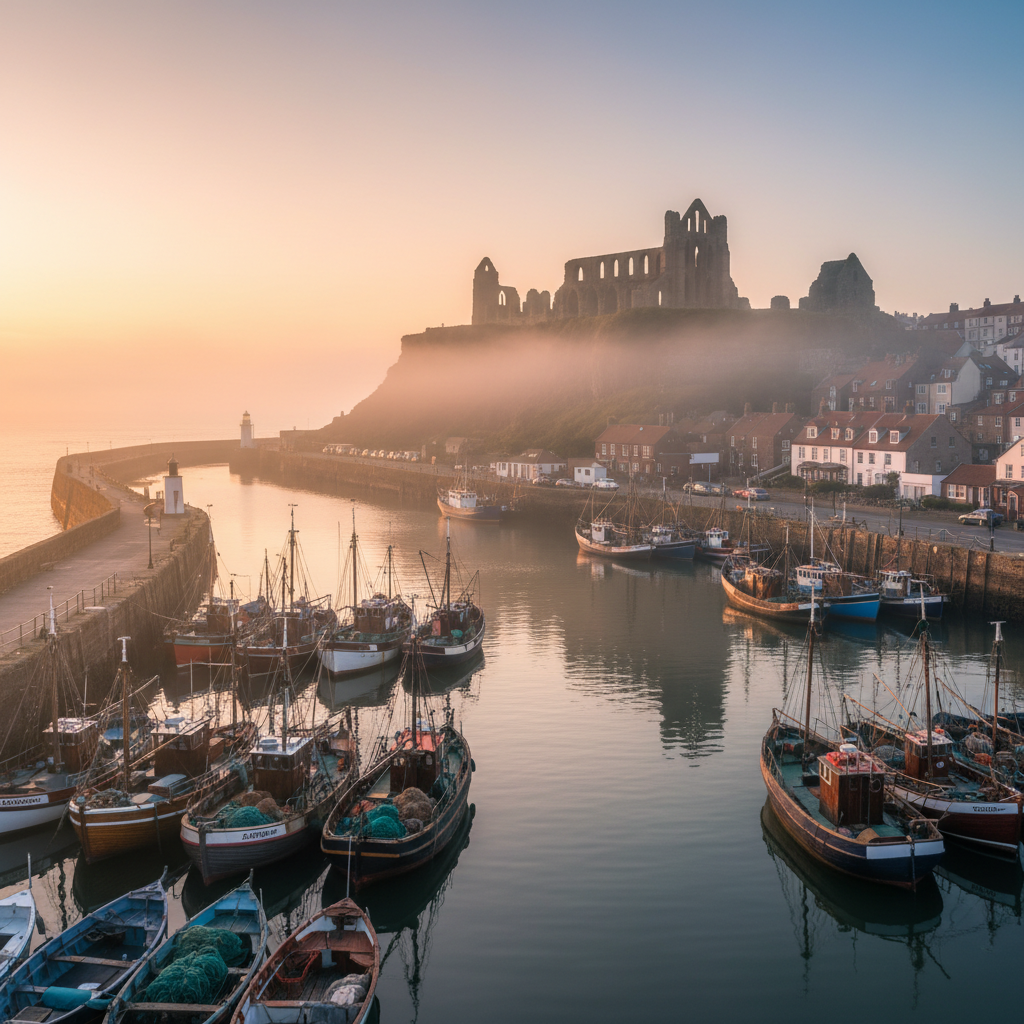
When I stepped off the train at Whitby Station, a gentle mist hovered over the North Sea and the path to the town lead downhill, away from the station. It was early autumn, and the air was crisp, the kind of sharpness that wakes you up in the morning. As I walked along the road toward the harbour, I could hear seagulls squawking in the distance, their cries echoing off the surrounding cliffs. The streets, lined with a mixture of stone buildings and weatherbeaten wooden structures, hinted at a long history of this seaside town that thrived on whaling and shipbuilding in centuries past.
Historical Context
Whitby has a history that dates back to the eighth century, marked by the founding of Whitby Abbey by the renowned Saint Hilda. The Abbey remains an iconic ruin towering above the town, its silhouette striking against the sky, particularly at sunset. This place is steeped in stories, from its role in the Christianization of the North to its enduring connection to Bram Stoker’s Dracula—a testament to its gothic allure. The history of this town is palpable, interwoven into the fabric of everyday life; as I walked around, I couldn't help but appreciate how the past continues to shape the present.
Walking the Streets
The centre of Whitby is compact; you can wander its cobbled streets without much plan. I found myself on Church Street, where independent shops and cafés beckoned. I noted a delightful shop selling handmade jewellery and local crafts, its window displays showcasing the creativity of local artisans. Nearby, several cafés offered steaming cups of tea, the steam curling up into the cool air.
“There’s nothing quite like a Yorkshire cuppa after a long walk.”
As I approached the harbour, the outline of Whitby Abbey took form above me, grey stones set against the backdrop of bright blue sky. I paused to appreciate how the sun sporadically broke through the clouds, casting fleeting light over the town. The streets were not crowded—it was a Tuesday, and the summer rush had subsided, leaving a calmness that made the atmosphere feel even more real.
Local Highlights
The marina glimmered under a thin veil of sunlight, with fishing boats bobbing on the gentle waves. On the stone pier, the salty breeze made my cheeks tingle. There’s a small lighthouse there, painted white, which stood as a sentinel of sorts, and I found myself compelled to wander along the pier, feeling the stone beneath my feet and the spray of salt in the air. I could see a pair of fishermen working, their hands busy with nets, seemingly oblivious to my wandering presence.
On the far side of the town lies the famous 199 Steps, a worn flight that leads up to the abbey. Despite my inclination to count each step, I found myself distracted by the views that unfolded as I climbed. Each turn offered a new perspective of the town, the sea, and the cliffs, where the foliage was just beginning to take on autumn hues. The steps were uneven and weathered; I felt the weight of history in each footfall.
Practical Observations
Parking can be a challenge, especially in peak summer months. There are a few car parks at the edge of town, but I noticed they filled quickly. Arriving early or opting for public transport, as I did, alleviates some of the hassle. For those planning to spend several hours walking and exploring, good walking shoes are essential—some paths are rocky, and the beaches at low tide can be strewn with pebbles.
Cafés and Pubs
As I descended the steps back into town, the scent of fish and chips wafted through the air, and I could not resist. I stopped at a pub along the bustling East Side, the Black Horse Hotel, where the décor was classic, featuring a mix of old timber and new upholstery. I chose the fish and chips, a plate generously sized and freshly made; the fish was tender, the batter light and crispy.
Later, I made my way to a café called the Royal Fisheries, well-known for its comforting meals and homemade cakes. Sitting there with a slice of lemon drizzle, I watched as the local life carried on. People cycled by, children played on the beach, and a few tourists wandered with their cameras, eager to capture the charm of this coastal town.
Seasonal Atmosphere
During autumn, Whitby takes on a quieter tone. The summer crowds have moved on, leaving behind a town that feels intimate yet busy with the locals going about their daily lives. The weather can be unpredictable; I encountered light rain and sudden bursts of sunshine, a reminder that coastal weather is capricious at best. Still, the cool sea breeze is invigorating, serving as a gentle reminder of the town's maritime heritage.
Closing Reflections
As the sun began its descent, painting the sky in hues of orange and purple, I found a perch at the edge of the beach. Watching the waves lapping at the shore, I considered how places like Whitby are shaped by their histories and environment. Each stone, each crumbling wall, tells a story—of the sea, of the people who came before, and of the enduring presence of both land and water. My visit felt less like a touristic dance and more like a quiet engagement with a corner of England that remains stubbornly true to itself.
Leaving Whitby was easy; the memories, however, stay. The town wrapped itself around me like a knitted scarf—comforting, familiar, yet impossibly complex in its layers.